How to play boules (these are the basics, not the Rules!)
The winning team is the first to reach 13 points. (In some competitions it is required to note the score of the losing team as the lowest “score against” can be the decider e.g 13 – 5).
Points are scored for each boule closer to the coche (jack) than the nearest opponents’ boule.
In doubles each player has three boules. In triples each player plays two boules. So six in all for each team.
To begin the game a circle of 35 to 50 cm is drawn on the piste.
The first player, having won the toss, stands in the circle and throws the coche – between 6 and 10 metres. He/she then rolls or lobs his/her ball, underarm, to get as close to the coche as possible.
When throwing, both feet must be on the ground and in the circle.
An opposing team member then tries to get closer. The same team keeps playing until one of its boules is closest. Then the other team plays and so on until all boules are exhausted. After each “end”, points are scored. Only one team scores. The end winners throw the coche to start the next end by making a circle roughly where the last coche finished.
Instead of “pointing” to get closest, a player may decide to “shoot” an opponent’s boule out of the way.
Diagram of How to Play the Game
Petanque can be played as singles, doubles or triples. Three boules are used by each player in singles and doubles, but only two in triples games.
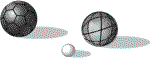
Boules are metal, weigh up to 800g, and have a diameter between 70mm and 80mm. The jack (or cochonnet) should be made of wood and have a diameter of 25mm to 30mm.
After deciding who starts by tossing a coin, a member of that team draws a circle on the terrain where each player must stand when throwing. The circle should be between 35cm and 50cm diameter and both feet must stay inside the circle while playing.
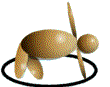
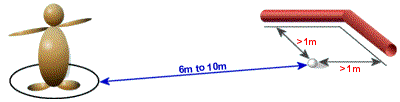
The first thrower throws the cochonnet to land between 6m and 10m from the circle and not closer than one metre from the terrain boundary
He then throws his first boule and tries to place it as close as possible to the cochonnet.
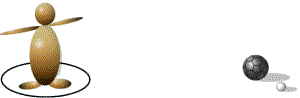
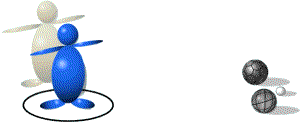
From the same circle, a player from the opposing team throws his boule, either trying to get it nearer to the cochonnet (pointing) or knock away the leading boule (shooting). The boule closest to the cochonnet leads. Any boule thrown outside the terrain boundary is considered to be out of play.
Players in the trailing team must throw until their team has a leading boule, or all the team’s boules are played. When a team has played all its boules, the other team continue to throw theirs, trying to place them closer to the cochonnet than the opposing boules.
After all boules have been played, the team with one or more boules nearest the cochonnet are the winners of that end. The points gained are equal to the number of boules closer to the cochonnet than the nearest of the opposing team.
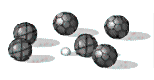
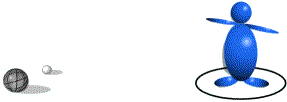
A new circle is drawn round the cochonnet, which is picked up by a player from the leading team and thrown as before. Play continues until one team reaches 13 points.
Some If’s
After the first boule, if the coche leaves the piste or hits the boundary, the end restarts with no score, except if one side has no boules left, when the side with boules wins and scores however many boules are still unplayed.
If a boule leaves the piste, it is removed.
If there is doubt about who is closer, a measure is taken. If still doubt, call 3rd party or umpire.
If you fail to land the coche between 6 and 10 metres, the other side gets to place it, but you still play the first boule.
Etiquette –
• Never throw a boule if a player or spectator is in front
• Remain quiet & still when someone is in the Playing Circle
- Don’t stand between the circle and the jack when someone is in the Playing Circle
- Don’t walk across other games
- Don’t smoke on the playing terrain